
Want to Give Birth With as Few Stitches as Possible?
Of course you do. Who wouldn’t?
But can you actually prevent tearing during birth - or at least reduce your risk?
What can you do to protect your perineum?
Does perineal massage really work?
And, perhaps more importantly, what else can you do?
First things first: don’t panic
There are things you can do before and during labour that may reduce your risk of significant tearing or an episiotomy.
But there’s something else I want you to remember.
Even if you do have a tear or need an episiotomy, your birth can still be a positive, empowering experience.
You can recover well, enjoy those early weeks with your baby, and come away feeling whole and proud of the birth you had.
So… where exactly is the perineum?
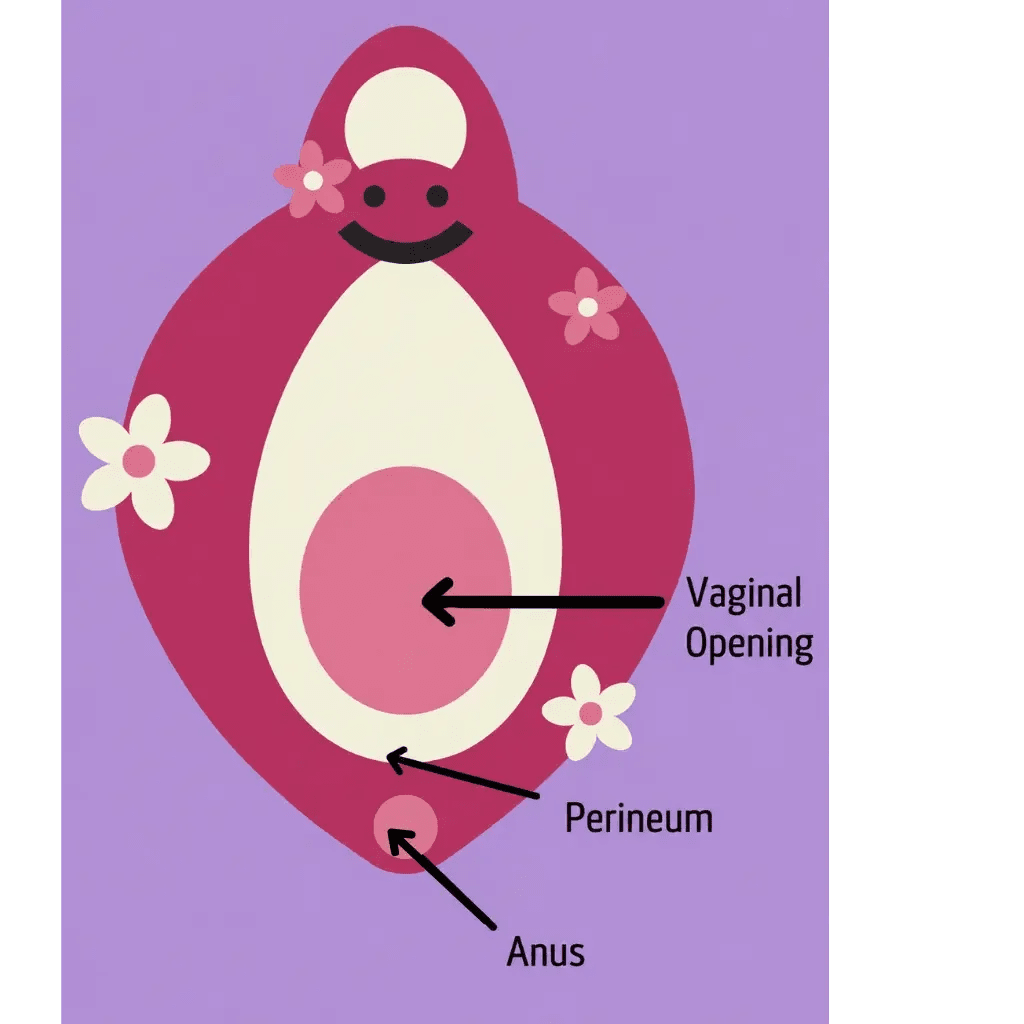
The perineum is the area of skin and muscle between the vaginal opening and the anus.
During birth, as your baby’s head reaches the vaginal opening, these tissues gradually stretch to make space for your baby to be born.
When the widest part of your baby’s head is visible at the vaginal opening, this is called crowning.
If you don’t have an epidural - and sometimes even if you do - you may feel intense stretching or burning as the tissues open around your baby’s head.
Want an idea of what that stretching feels like?
Put two fingers at the corners of your mouth and gently stretch them outwards.
Some women find crowning very intense.
Others are surprised to find that this part isn’t particularly painful and may even feel easier than the contractions that came before it.
Why a slow birth of the head can help
Especially with a first vaginal birth, your baby’s head will often move forwards during a contraction and then slip back slightly when the contraction finishes.
Forward. Back.
Then a little further forward.
Eventually, the head stops slipping all the way back. With the next few contractions, the tissues stretch further until they surround the widest part of your baby’s head.
This gradual process matters.
It gives the tissues time to stretch and adapt rather than having the head come through all at once.
And this brings us to the question everyone asks…
Are we finally at the perineal massage part?
Well… not quite.
After years of perineal massage being treated as the thing you need to do to prevent tearing, the research has come back with a much less exciting answer: there isn’t clear evidence that antenatal perineal massage actually reduces your risk of tearing during birth.
So, if perineal massage feels good to you and you want to do it - absolutely, go for it.
But if you don’t?
You can take that particular job off your must-do-before-baby-arrives list.
Because there are plenty of other things worth thinking about when it comes to protecting your perineum - both before and during birth.
Before birth: become friends with your vagina
One of the things I want you to practise is being able to consciously soften and release the muscles around your vaginal opening - including when you feel stretching or pressure.
Get comfortable touching the area and noticing how your body responds.
You can gently explore the sensation of touch and stretching while practising slow breathing and consciously releasing tension.
This doesn’t need to be a formal “technique”.
Think of it as getting to know your own body and learning what helps it soften rather than brace.
If you notice significant sensitivity, pain, involuntary tightening or emotional difficulty around vaginal touch, consider seeing a pelvic health physiotherapist who has experience in this area.
You can also practise visualising your baby moving down and out while your body softens and opens around them.
During labour, this can become a familiar image to return to.
Look after your perineal tissue
Healthy tissue is better able to stretch and adapt.
If you have vaginal thrush or another infection, get it treated rather than simply putting up with it.
If you have scar tissue from a previous birth, a pelvic health physiotherapist can assess it and show you appropriate scar massage or mobilisation if needed.
Help your baby find a good pathway through the pelvis
The way your baby’s head enters and moves through the pelvis can affect how much space it needs.
Ideally, the head is well flexed, with the chin tucked towards the chest.
When the head is more extended or tilted to one side, a larger diameter may need to pass through the pelvis and vaginal opening.
There’s no exercise that can guarantee the “perfect” position, but certain exercises during pregnancy can support your baby’s positioning and balance.
If you’re unsure about your baby’s position, talk with your midwife, doula, or a practitioner who specialises in balanced birth.
During labour, stay mobile and change positions to help your baby rotate and move through the pelvis.
During labour: give the tissues time to soften and stretch
This is where everything you practised beforehand can come into play.
Use your breath to release tension.
You might say to yourself:
“I’m letting go.”
“My body is softening and opening.”
“There is space for my baby to come through.”
Return to the images you practised during pregnancy - your baby moving down, the tissues softening, your body making space.
And ask your midwife about a warm compress on the perineum as your baby’s head is being born.
Warm compresses are one of the better-supported techniques for reducing the risk of severe perineal tears.
Touch should help you soften - not make you tense
Your baby’s head is already providing powerful, gradual pressure from the inside.
Some women find skilled, gentle perineal support or massage from their midwife helpful. Others find external or internal touch distracting, uncomfortable or something that makes them instinctively tighten.
Pay attention to your response.
If your midwife’s touch feels uncomfortable, intrusive or makes you tense, tell her.
You can ask for less touch, external support only, or a warm compress instead.
You are allowed to say what helps your body feel safe enough to soften.
Let your body lead - and give your baby time
If you can clearly feel the urge to push, you may find that your body gives you very clear information about when, how and in what position to push.
Rather than thinking only about pushing harder, think about making space and allowing your baby to come gradually.
This becomes particularly important as the widest part of the head is being born. You don’t necessarily want the head to suddenly “pop out”.
Giving the tissues a little more time to stretch may help protect the perineum.
Follow your body and change positions when you need to.
A side-lying position can sometimes be useful when you want to reduce the effect of gravity and slow things down.
And if your midwife asks you to stop pushing and breathe or pant for a moment as the head is crowning, there may be a very good reason: slowing the birth of the head gives the tissues more time to stretch.
Gentle support from the midwife’s hand may also help control the speed at which the head is born.
And remember:
an intact perineum isn’t the measure of a good birth
Yes, there are things you can do to reduce your risk of tearing.
Prepare your body. Get to know your pelvic floor and perineum. Stay mobile. Work with your baby. Use warmth. Breathe. Soften. And, when the time comes, give your tissues the time they need to stretch.
But birth isn’t an exam, and an intact perineum isn’t the grade at the end.
If you do tear, it doesn’t mean you did anything wrong.
The goal isn’t a “perfect” birth.
It’s a birth in which you understand what is happening, can work with your body, are treated with respect, and come out the other side feeling that the birth was yours.
Naama Sela - Birth Doula and Childbirth Educator
